10 June 2015

"Paleo" "Cereal"

I'm slowly dialing in my version of "paleo" "cereal", which is neither strictly paleo, and not cereal at all. I want a breakfast that is nearly as easy as a bowl of cereal, but way better for me. My requirements:

- Easy
- Filling
- Lots of protein to support my training regimen
- Lots of fiber because I'm in my forties
- Made of whole foods
- No dairy, starch, sugar
- Shovel-able, scarfable (sorry, Mom, all those table manners you drilled into me only kick in after 11am)
- Delicious enough that I eat LOTS of vegetables


This is a bowl of half an entire package of organic frozen leaf spinach, microwaved 2 minutes, topped with 1/4 c of white beans (thus not really paleo) and a 1/2 chopped andouille sausage, microwaved another minute, topped with two slow-poached eggs.

The slow-poached eggs coming along. They were fussy at first but I've got a good system now.

- 3 cups tap water in the rice cooker (reliably 68F in summer)
- Heat for 16 minutes (reliably bringing it to 177F)
- Add two large pastured eggs (look at those yolks!)
- Remove 14 minutes later and crack over my "cereal"

A grind of pepper and a splash of olive oil and commence shoveling.

All-told, this is very, very little actual effort. Mainly dumping stuff from one container into another and hitting buttons.

The next step is to move the whole affair to the microwave entirely.

20 January 2014

Bo Ssam Triumph!

My gym held a "Paleo potluck" this past Saturday. I had no idea it was a competition, but it turns out that I won! I wanted to post the recipe here. Basically, I did David Chang's bo ssam, which is a Korean pork shoulder lettuce wrap. You can find that recipe here. I don't have any pictures of my entry, but here's kinda what the pork shoulder looked like.

Not my pork shoulder, but I got similar results. Source


But that recipe includes a lot of sugar on the pork shoulder, so I rather did the pork shoulder from this recipe on Serious Eats. Plenty of people commented on how they'd been able to roast pork shoulder successfully, but had never gotten the crispy skin that I was able to get. I followed the Serious Eats recipe to a T, with only a couple of diversions.

Salt

Adequately seasoning a pork shoulder is pretty much impossible. There's too much meat for too little surface area, and the skin prevents any seasonings from reaching the meat underneath. You could inject it or brine it or whatever, but that's a big hassle and a lot of time. The best thing to do is add flavor at serving time. That's what all the sauces and accompaniments are for.

So why salt at all? You salt the shoulder to get the crispy outside, not to season the meat. Copious salt is essential to getting the crispy skin.

Unwrap the shoulder (also sometimes called Boston butt) and rinse it. While still wet, massage as much kosher salt into all sides of the shoulder as you can in about five minutes. Keep going. It will soak in. This is pretty much all the prep you're going to do, so you can take your time here. Leave whatever salt will stick to it and put it on the parchment.

You might be tempted to make use of all the nice brown bits on the parchment and pan, but don't. The drippings will be inedibly salty. Let it go.

Temperature

I've had mixed luck with the old "low and slow" adage here. Reducing the initial roasting temperature by 25F can lengthen the time it takes to get really tender by 1-2 hours. This is not a cut that overcooks easily. My choice is generally to roast at the highest temperature that will still give me a tender interior. 

I did 275F in a convection oven and got great results. You can really see when the shoulder "collapses". At that point, you can take it out and let it rest for up to 2 hours. It's much better to have a shoulder ready to go for 2 hours before your guests arrive than to be eating 2 hours late because you chose to go too low-n-slow.

For the crisping portion (10-20 mins at high temp), I chose 500F, but I maybe could've even done 475F. You want a temperature high enough to crisp the skin but not so high as to burn it.

Sauces

I really think the scallion-ginger sauce benefits from having the ginger hand-chopped. Food processors mash up the fibers too much.

I did not do the ssam sauce in the David Chang recipe. I actually prefer bi bim bap sauce because it's not as vinegary and has fewer specialty ingredients. I served both at a recent dinner party and folks much preferred the bi bim bap sauce, even though it's not traditional.

My bi bim bap sauce is pretty much equal parts gochujang red pepper paste, toasted sesame oil, sherry vinegar, and water. If you're not strict Paleo, you can add sugar or agave to taste. Crush a garlic clove or two into it, stir and let sit.

Ingredients

For locals and gym members, the Korean specialty ingredients are available at the supermarket near the American Apparel on Flatbush and Park. Kimchi and gochujang are there, and they have great Bibb lettuce for the wrap portion.

This was fun to make, fun to eat, and fun to talk about. It was also fun to win something at my Crossfit gym, because lord knows I will not be winning any timed workouts any time soon. :)


04 October 2013

The Stone Fence Cocktail with Caramel Apple

We had a "cider bash" last week at Fog Creek, rather than our customary "beer bash". The place was stocked with hard cider and a bunch of other apple-related paraphernalia. I mentioned to my friend Bradford that it was a shame we didn't have any rye whiskey, as then we could make Stone Fences. A Stone Fence is hard apple cider and rye whiskey over ice.

Magically, a bottle of rye appeared and we were a go!


The Stone Fence traditionally calls for some Angostura or other bitters, which we did have on hand, but decided to omit. On a whim I cut up a caramel-nut apple and garnished the glass with a slice. I thought it was visually appealing, but it was Bradford who kept his garnish on his glass and pointed out that inhaling the scent of nuts and caramel while drinking the apple-and-rye cocktail was amazing. And indeed, it's just what the cocktail needed.

There's precedent for this in [one interpretation of] the traditional mint julep, which is to pour bourbon and simple syrup over shaved ice and garnish heavily with mint. Serving with a short straw forces the drinker to plunge their schnozz into a bouquet of mint.

The same principle applies here.

A recipe here for your convenience:

2 oz. rye whiskey
ice
6 oz. hard apple cider
A nut-coated caramel apple

In old-fashioned glass, pour the rye over ice, then top up with cider. Garnish with a wedge of caramel apple.

photos: @bmccormack

15 May 2013

The Frito Omelet

Every other Wednesday, I cook omelets for the people in my office. I do it right before our biweekly all-hands meeting, so it makes for a full morning, but it brings people together informally on a day we're going to get together formally, and really strikes a nice tone for the morning.

A couple days I had a brainstorm. I really wanted to get the eggy-corny taste of migas or chilaquiles in an omelet. Rather than frying my own tortillas, or getting some fancy chips and crushing them up, I went with Fritos.

"But, Rich," you say, "Don't you abhor processed foods in all forms? Isn't that part of that fancy, snooty, foodie thing you've got going?"

To which I say: read the ingredient list of (original) Fritos.
Corn, corn oil, and salt
Do not substitute chili-cheese Fritos or any other newer version. Only the original Fritos are made with 100% pronounceable and understandable ingredients.

This is the omelet technique I've been perfecting at home every morning for M and my daily breakfast. I haven't got it down perfectly, but I am making nice, custardy, football-shaped omelets every morning. (For daily consumption, we use two egg whites and one whole egg, cooked in coconut oil with a ton of veggies, like shallots, mushrooms, spinach.)

Luckily, you don't need to obsessively perfect your omelet or scrambled egg technique in order to get the goodness of Fritos. Just add some crushed Fritos to your regular scramble or omelet technique, about when you would normally add the cheese. For those who want a recipe, though, here's a guess at an ideal migas omelet:

Migas Omelet

1 tsp butter or vegetable oil
2 eggs
2 tsp bacon bits
1 tsp chopped chives
1/4 tsp chili powder
2 tbsp crushed Fritos
2 tbsp cheese, preferably pepper Jack

Garnish:
Sliced avocado
Pico de gallo or fresh salsa

Heat butter over medium heat in a nonstick pan. Beat eggs with bacon bits, chives, and chili powder. Pour into pan and cook as you would a normal two-egg omelet, or two-egg scramble.

Before things firm up too much, add the Fritos and the cheese. Heat through until the cheese is melted and garnish with avocado and pico de gallo.


The Pleasures of Running Lean

There was a recent event that was mindblowing and I want to go into raptures over, but I'm going to hold off on talking about that for now.

I wanted to talk about a change in the way I've been stocking my kitchen and running the food in our two-person household. By "lean" I mean like a startup, not lean like chicken breast. And I definitely don't mean "running" in that sense. I mean only keeping a bare minimum of produce and meat in the fridge, forcing you to shop and make some decisions during the week.


Brown Bag Lunch in Black and White

Recently, I've been taking a great deal of pleasure in not stocking the fridge for the week. Over the weekend, we had been planning our dinners for the coming week. Doing this has given me insight into what the throughput on our kitchen actually looks like and has forced me to change how I cook. Planning ahead has some great advantages, chief among them that you can stock the fridge with healthy food. But not planning ahead can have real benefits, too.

Faster and Easier Meals - By this, I mean that when I'm planning on Sunday, I'm far more likely to believe that my Wednesday self will want to cook something challenging, time-consuming, or involved. But the Wednesday me wants something basic and satisfying. If you want another example of this phenomenon, check your Netflix queue. How many challenging foreign films are there? That's because all the basic, satisfying, funny ones done got watched.

You'd expect that short-term shopping makes for poor choices, health-wise. There's some pretty good studies around the idea that we'll make unhealthier choices for our near-term selves. But I've never been very good at forcing myself to eat things that are unpalatable and (putatively) healthy according to the prevailing wisdom (v.s., chicken breast). When I swing by the market on the way home, I'm much more likely to choose something that'll take less time, and will be less complicated, and result in fewer pots and plates to clean. A


Less Food Waste - We find that we waste far less food by buying only three dinners per week at the weekly supermarket run, and filling in with takeout or leftovers for the rest of it. My office has lunch catered with leftovers a tasty side benefit. That will supply at least one meal a week. I just have to not mind eating the same thing for lunch and dinner (which I often don't). It's galling to throw away expensive wilted produce.

Fresher Food - If you try to eat seasonally and locally, it left the farm two days ago. Why make it then linger in your fridge for four days? Our food co-op runs through it's entire inventory in six days on average. Produce turnover is much faster, on the order of four days. After reading Harold McGee, I'm much more aware that the kale in the fridge is not an inert green thing just waiting to be eaten. It's a living thing--or, more gruesomely, a slowly dying thing--and living things need nutrients. From the moment it's picked, produce starts to digest itself.

More Serendipity - Wandering through the market. "Hey, I've never cooked veal breast before. I wonder how you do it." One hour in the pressure cooker with dried porcini reconstituted in broth, and an onion. Mix in a dab of cream and serve. Heaven. And I never would have (or should have) planned it. It needed to happen on a night where I had a bit of time to play with. And it did.

Clearer Vision - I may be alone in this, but when there's too much variety in my fridge, I can't "see" what's there. I suspect I'm not alone, though. There's good science on how too many choices can be harmful. Contrary to the ice-cream-and-vegetables experiments above, real-time choice is as much of a factor in healthful eating as anything. A bursting-to-overflowing produce bin is more likely to get ignored in my house because I can't "see" what's in there to remind myself that we were meant to have the Tuscan black kale salad with Meyer lemon caper vinaigrette tonight (so good).

Hmm, looks like there's at least two recipes I have to get out on the web.


22 March 2013

Momofuku-style Corn with Shrimp, Bacon, and Miso Butter

I really liked David Chang's recent PBS series "The Mind of a Chef". It really gets across how transformative it is to be exposed to real Japanese food (not just sushi). I wanted to try this recipe and so I used frozen sweet white corn. I also added 10 shrimp each to make it a complete meal, because shrimp go so well with corn.

Here's an approximation of what I did:

3 slices bacon
1 onion
20 medium (21-30) shelled shrimp
1 package frozen sweet corn
2 tbsp white miso (probably been in the fridge for 18 months, which is fine)
2 tbsp butter, softened
2 eggs

Combine the miso and butter with a fork.

Fry the bacon, remove. Pour out some of the fat, if necessary. Cook the onion in the bacon fat. Add the corn. When it's near heated through, add the shrimp and toss until just cooked. Then, re-add the bacon and miso butter and serve, topped with a soft-poached egg.

The miso gave a complex, almost wine-y flavor to the dish, but the corn was just too sweet. If I was to make this with frozen corn again, I'd get plain old Bird's Eye frozen corn. It'd be a bit more toothsome and satisfying. I'd also use thick-sliced bacon to make it more substantial.

Even better, I'll wait to do this again until late summer.

31 August 2012

The Cotswold Way

This August, my wife and I took a week with two friends who live in London to walk the Cotswold Way. The Cotswold Way is a 102 mile ramble through some of the most quintessentially English countryside there is. Sheep, churchyards, villages, and quaint pubs. There's a decent amount of information out there about it, but it was still quite a bit of work getting the trip together. We decided for several reasons to hike the Way from south to north rather than north to south, which is the usual way people do it. The most compelling of these reasons was that the southern end is 2 hours from Heathrow airport, not 2:45, and we were going to be coming into Heathrow late.

You can see the other couple's blog post, including pictures here. The pictures don't do it justice. It's just fields and sheep, but it's stunningly beautiful up there. I just wanted to get down some of my thoughts about the trip. I planned it down to some very small details, including which pubs we'd be stopping at. We researched and bought a lot of new equipment. Here's some things I learned:

1.) Under Armour compression shorts, silk sock liners, Gore-Tex, wicking shirts - These were my ammunition to be able to walk/hike long distances. I'm a big guy, but I'll get up and down the hills eventually. What really has taken me out of a lot of hikes is moisture management. I know that sounds gross, but chafing and blisters are the biggest nuisances for me in hiking. We were lucky with the weather. Very little rain and right around 60F the whole time (in August!).

I also loved my Merrel trail runner with Superfeet Blue Insoles. The plantar fasciitis I've been battling all summer barely raised its head!

2.) Twelve miles a day is fun. Sixteen feels like a job. - We had a range of fitness levels and body sizes on the trip, but we're all pretty active. All of us started getting sore feet at mile 12 every day. Anything over 12 felt like a slog. Also, the amount of time you have for other things, like sitting in the grass, gets squeezed. That extra hour and a half of walking is when you could otherwise be relaxing with a book in the pub, or taking a nap, or soaking in a bath. We loved the walking. By the end of the week, we all agreed we'd love to keep going, all had a new thought about a walk we could take in other countries. But the schedule was just a little too aggressive.

2a.) 12x7 < 102 - You'll see all over the place that most people take 6 to 15 days to finish the Way, and that the average is 7. Don't worry about that. If you're going to do it, take longer. Because of the spacing of villages, especially in the middle section, you might have to walk 16 or 18 miles one day. But otherwise keep it to 12 or so and just take some more time. A down-day in the middle would have been heaven, too. Especially if we'd been able to swing a massage.

3.) Pubs close from 3-6 - And they're often the only business in some of these villages, so if you're going to be walking through a village like Stanton or Tormarton at 4pm, there's nowhere to stop for a snack or a drink. Best to just stop in a field with a nice view.

4.) Stay in B&B's and Hotels, not Pubs - The pub food was middling all along the Way. The pubs were great, and it was nice to eat dinner, have a couple of pints, and stumble upstairs at 9pm. But the bed that awaited you might be small and lumpy, in a loud room that smelled of fryer oil. We loved the charm of the Crown & Trumpet in Broadway, but would gladly have spent the extra few pounds to stay at the Lygon Arms. Valley Views B&B in Middle Yard was a standout. Pam was amazing.

The restaurant meals we had were really good. We loved our fancy restaurant dinners at 5 North Street in Winchcombe and Russell's in Broadway. The Falcon Inn in Painswick was also a really nice lunch in a classy pub-like atmosphere.

5.) I don't get tired of full English breakfasts. - That is all.

6.) There is a Stratford in Canada. - It has something called the Stratford Shakespeare Festival. If you go to Stratford-On-Avon and try to attend one of Stratford, ON's plays, they will be very confused. This will all turn out fine in the end, though.


7.) I didn't like the beer as much I thought I would - This was a surprise. My benchmark was the Bow Bar in Edinburgh (i.e., The Greatest Bar in the World), though, so I might have come in with some high expectations.

I've been brewing for three years now and had been rather enthralled with English ales. I've made Old Ale, Mild, Best Bitter, and a bunch of others, with a variety of yeasts. I was excited to try a bunch of different cask ales over the course of the trip. But even the best places had only one style on offer. They had three or four different kinds of bitter. No milds, no stouts. A bit disappointing.

But these places are listed in the CAMRA Good Beer Guide! They are the standard bearers for classic English beer. This is a dying art. It has as many rules as Dogme 95! How can it not be good?

Well, it was good-ish, but they weren't all that different from each other. The craziness of the American beer scene can get exasperating, with people trying to outdo each other using crazy amounts of hops, but it at least has a lot of variety, taste-wise. I'm not saying that one cannot be a casked English bitter aficionado. I'm just saying that I will never be one.

There were a few blonde bitters which were moderately interesting, and a couple of experimental ones made with New Zealand hops. I really enjoyed those... probably because they had some of that New World hop flavor.

I really appreciate what CAMRA is doing, but English beer is just not for me. Good to know.

Cider, on the other hand, was amazing. We found a lot of different types. Ashton Press won the prize among them. Stowford Press from Weston was a distant second.

8.) I want do to more of these!

Overall, it was a great trip, with some excellent conversation with great friends, lots of good times, lots of great views and nice moments. Lots of meditative walking, a little bit of exertion, and just a lot of fun.

I was worried about spending a full week walking with another couple, but strolling along and chatting is actually very easy. It helped that they're really easy to talk to.

I'd do another long-distance walk in the UK in a heartbeat. In fact, now that I know how to plan one, I'm practically required to use that knowledge to make the next one awesome!

A gentleman we met on the Cotswold Way spoke very highly of the Coast to Coast Path, which goes through the Welsh Lakes District, the Yorkshire Dales, and the North English Moors. Sounds amazing.


24 May 2012

Trello for Recipes

The company I'm lucky enough to be a part of, Fog Creek Software, makes a very flexible application called Trello.

It's not really a to-do list. It's just a flexible place to put a bunch of stuff online, and edit it and organize it. Really, the tagline says it best: Organize anything, together.

Anyway, I've had friends after me to get some recipes online, so I decided to use Trello to publish some of my recipes and also keep track of the recipes that are in my head, but not written down anywhere.

Right now, it's got some of my recipes, but those are outnumbered by awesome recipes I found online somewhere. Those are already written down, after all.

So here it is, RichCooks Recipes on Trello. You can vote and comment on recipes if you create a Trello account.


15 May 2012

A Simple Ratatouille

Ratatouille gives me the shivers. The sliminess of eggplant, combined with the cooked pastiness of tomato paste, finished with stale dried herbs. I never think, "I want ratatouille."

But the thing is, without giving myself too much credit, I make great ratatouille. I have converted several people.

I love it tossed with orecchiette and topped with cheese, as in this picture (Sorry for the blur. I'm no smittenkitchen.com.)


Finished with garden-grown chives and a chive flower, this was a simple, healthful vegetarian dinner, and it's really simple.

I've started keeping my recipes publicly available on trello.com. Thus, when I improve and tweak them, they're not frozen in time in a blog post.

Here's the link to my ratatouille recipe. The basic idea is you get one of each vegetable involved, chop, saute over medium heat in the correct order, toss in a can of diced tomatoes, and you're done. I might try this again with fresh tomato once they're in season.


14 November 2011

Bastardized Rum Drinks, Part 2: Emergency Mai Tais

I have an Indian cookbook called 660 Curries. It's pretty good as a comprehensive survey of Indian cooking, but the first step in every recipe should really be: "First, quit your job." I understand that this is the nature of Indian food, but I'm much more comfortable with Madhur Jaffrey's At Home with Madhur Jaffrey, which I just picked up and intend to put through its paces very soon. It's got nice-looking recipes using a human number of ingredients and only a few recipes refers to some spice mix you will have made 72 hours earlier.

My energy level and mood at the table is probably the most important thing about a dish I make. If I'm ragged from effort by the time I sit down to eat, I just won't have a good time. It took me a couple decades of entertaining to understand this.

Still, I am tempted by the prospect that an extra infusion of effort will uncover a new vista of flavor. When it works and a new technique uncovers something transcendent, it's a peak experience for me. It can stay with me for years. So every now and then, I see a recipe which, however assily complex, slips through my filters.

This mai tai recipe from the New York Times is the most recent. What, like I'm going to let big-time corporate agribusiness tell me what my orgeat syrup should taste like? Me? No way. I went ahead and made the homemade orgeat syrup before seeing the first comment:
So, the critical ingredient is perfect Orgeat syrup--specifically 1/2 ounce thereof. And to make that you start with a little over a pound of almonds... Oh, well, at least I don't need to start with planting an almond tree.
Doh. The commenter was right. I'd been sucked in again. Well, the one half of the orgeat syrup made a nice gift for a Giant Toad. I ended up throwing out almost all of my half a few months later.

Fast forward to August 25th of this year. Hurricane Irene had just driven us northward from the Outer Banks of North Carolina, where we'd been vacationing. A much-anticipated vacation had just been busted out in the middle of a perfect week. We drove back on Thursday all day, arrived home ragged and worn out, ready to brace for the hurricane, which was conveniently following us home from vacation.

Maybe only certain people know this, but hurricanes usually have awesome weather at their periphery. All the sucky weather is in close to the eye. We had one more day of sunshine before Irene descended on New York City and we decided to make the most of it.

We took our rental car out to Jacob Riis beach. I brought along refreshments in the form of Emergency Mai Tais. Provided you have the requisite cooler to transport it, the entire thing can be ready to go in 5 minutes. And if you're not picky about your OJ (i.e., you don't mind concentrated, considering all the other flavors in there), you could conceivably make this entirely from pantry and freezer ingredients, so you can technically have the makings on hand at all times.

1 can (46 fl. oz) pineapple juice, any brand.
2 quarts orange juice, frozen concentrated is fine.
1 bottle overproof rum (Lemon Hart Demerara 151 is preferred)
1/4 cup grenadine syrup (next to the bloody mary mix)
1 tbsp almond extract (yes, from the baking aisle)

Mix all ingredients with some ice in a dangerous-looking 2 gallon cooler. Ours is orange, but this red one from Amazon sends a sufficient signal to beware.

The Lemon Hart rum is really essential here.... but not for the taste. It's more the label design, which fits with the sort of 1970's supermarket groove we've got going here. This is the kind of rum that says "There's such a thing as fresh asparagus?". Seriously, though, it's very tasty, but you could substitute a bottle of almost any 151+ or two bottles of 80 proof if it comes to that. In an emergency, you have to be flexible.


09 September 2011

Bastardized Rum Drinks - Part 1 - The Papazerac

I'm all for the classics, but I'm also completely in favor of bastardizing the hell out of them to suit your needs. This year, I've enjoyed and destroyed several classic rum drinks, and had fun doing it. Here's the first:

I love the classic papa doble or Hemingway daiquiri.

Papa Doble
2 oz white rum
juice of 1 lime
generous portion of grapefruit juice
slight dash of Luxardo Maraschino
Shake and serve on the rocks.  
When I went to Hilton Head with my in-laws this year, we spent a lot of effort punishing my father-in-law for the mistake of saying we could put anything we wanted on his open tab at Pool Bar Jim's on the beach. They do fantastic frozen drinks, but they're not classicists by any stretch. These are drinks for the Jamba Juice crowd (albeit much, much better than anything you'd get there).

Jim's recipe for a papa doble includes the cardinal sin against the purist version: substituting maraschino cherry juice for Luxardo Maraschino liqueur. Yes, maraschino cherry juice comes from almond extract, whereas Luxardo is actually made from cherries. But food scientist Harold McGee will tell you that cherries actually have a strong almond component to their flavor in the form of benzaldehyde, so what's the big deal? It's a frozen daiquiri. You've got all that ice stunning your tongue into submission. You can't taste the rum. You think you can tell the difference? And you actually care? You're on the friggin' beach and someone else is paying for the drinks! Shut up!

Now, though, just to make things easier, whenever I'm at a beach bar with frozen drinks--which is surprisingly often--I just ask for a grapefruit daiquiri and that does the trick. It's amazingly refreshing.

I discovered that the smokiness of a solid single-malt Scotch whisky makes a wonderful backstop to the flavors of a papa doble. So I came up with the Papazerac, a papa doble made with the same process as the iconic Sazerac cocktail of New Orleans, with a Laphroaig rinse.

Laphroaig is a powerfully flavored whisky, and not everyone likes it, but its power makes it come through the rum, sourness, and sugar in this drink wonderfully.

Papazerac

  1. Fill an old-fashioned glass with ice and let chill while you make the rest of the drink.
  2. In a mixing glass, muddle one lime with sugar to taste.
  3. Add two tablespoons fresh-squeezed grapefruit juice, a dash of Luxardo maraschino liquer, and 2-3 oz white rum.
  4. Top the mixing glass with ice and shake vigorously.
  5. Discard the ice from the old-fashioned glass, pour a generous dash of Laphroaig into the glass, swirl, and discard.
  6. Strain the mixing glass into the old-fashioned glass, garnish with a grapefruit peel twist, and serve.
Drink twenty to thirty of these and you will have gotten through your bottle of Laphroaig pleasurably without actually drinking any. As with the absinthe in a Sazerac, do not actually drink the rinse out of the glass. Control your urges and just throw it out. If you feel bad about that, just use less. If you drink it, you'll wreck your ability to taste its subtle underpinnings in the drink, which is the whole point.

If you can't bear to waste whisky, put it in a shot glass and re-add it to your drink as necessary to preserve the smoky flavor.

Next: Emergency Mai Tais

30 March 2011

One Great Pan vs. One Great Knife

I've got a pretty well-stocked kitchen, but often get questions from folks who want to know where to spend money when they're expanding beyond the basics. Of course, the two most basic pieces of kitchen equipment are the knife and the cooking vessel. (Well, before that, the heat source, of course, but you're less likely to have much choice in that matter.) So, if you're going to spend-up on only one, which should it be? And what should you get. Well, it starts with three levels of equipment: OK, good, and great.

The OK Level


This is the province of the Ikea starter kitchen set, and the place where most people end up. It's fine for those who think more about what they're going to eat tonight than what they're going to cook tonight. Or for those who don't really think about food at all. If you're one of those, you're probably not reading this.

The Good Level


It seems like the first level of kitchen equipment hovers around $60-70. I noticed back when I got out of college that I was quickly going into debt, and most of the purchases that were sending me there were in the $60 range.  Anything in the high $70 range sort of gets rounded up to $100, and it's easy to see where an extra $100 might mean making your rent that month or not. But what's sixty bucks?

In my 20's, I accumulated a lot of cookware and other stuff in the $60 range. Here's the thing about it: It looks like the Great level of cookware, and performs at the OK level. It's almost always a waste of money. As long as what you're cooking with is not actually flimsy or poorly made, you're fine sticking at the OK level.

The Great Level


Okay, so you're going to shoot the moon. You've committed to spending $200 or more on a piece of kitchen equipment. What do you do?

Knives

Japanese. All the way.

German drop-forged knives are the standard in American kitchens, but they're usually too chunky to comfortably chop vegetables, which is the most frequent task they'll be used for. The standard chef's knives are ridiculously large and heavy for the skill level of the people who typically use them. They're also usually sold as part of an expensive set, which appears to come with a bunch of extra knives that might be useful, but really just costs money for something you'll rarely if ever use.

Misono 440 Molybdenum Santoku
Go to Korin Japanese in lower Manhattan or korin.com. Japanese knives are really amazing. They're sharpened on a bevel, so that one side of the knife cuts straight, and the other side pushes the food away from the cutting edge. Much more stability and safety. The Misono santoku is my favorite all-round knife in my kitchen. Light, nimble, but substantial enough to work with. Holds an edge forever, but is relatively easy to sharpen.


I'm also a huge fan of virgin carbon steel, too. I have two knives, a gyotou and a petty. One from a stall outside the Tsukiji fish market in Tokyo, the other from Korin. You have to be a bit careful with carbon steel, because it's brittle (no frozen food) and not stain- or rust-resistant. But, man, does it take an edge. It looks ugly, but gets sharper and stays sharper than anything else. The only downside is the marital strife it causes when my wife uses one to cut a lemon, then leaves it rusting in the lemon juice. Aaargh! (But, of course, she goes for my carbon steel knives every time because they're light and sharp and a pleasure to use.)

One of the most obvious disadvantages is that the knives need to be sharpened a specific way. Luckily, if you don't want to invest in a water stone and developing your sharpening technique, there are plenty of specialized sharpeners at reasonable prices.

What to use while you're saving up

If you're not going to go Japanese, go Victorinox. You'll spend $67, with shipping on these three knives, and they should be enough for most kitchens. Victorinox knives are priced at the OK level and they perform at the Good level.

Knife care: Invest in a block or magnetic strip to hold your knives. If you're going to put them in the dishwasher, expect to sharpen them (a pain) a lot more often. Keep them sharp to minimize accidents. Take a knife skills class; it'll save you time in the kitchen... and maybe an injury or two.

Cookware

Copper. Sorry. That's just how it is. Preferably Cuprinox. This Mauviel saucier is my favorite.


This is it. This is the desert island pan. I use mine every day. Oatmeal, sausage, marinara, steak, stew, stir-fry, braised short rib, frittatas, stuck pot rice. It just never gets put away. It stays on the stove.

I easily have a dozen other pricey pots and pans (many handed down from my Mom), and you can keep all of 'em. I almost never use them. I wish future-Rich had been around the first time I bought a piece of expensive cookware and told me to get the Mauviel saucier instead. That Le Crueset bouillabaise pot was great for my 20's, when my most frequent big cooking project was a gumbo or a big chili for a party. Now, I want something light and responsive, which copper is. I find the shape so easy to work with for many different uses. These sauciers are getting hard to find, which is a shame.

Side note: I seriously wouldn't ever have gotten this pan if it hadn't been for a mistake. I was testing out different wedding registries in 2008, and put this on my registry. My very generous and kind uncle John was searching for my registry online the same day. I put the saucier on thinking "I wish," never really intending to put it on the registry because what kind of filthy yuppie spends $300 on a single pan. Uncle John snapped it up and it arrived later in the week. Back then, it was way more gift than I'd ever have thought to ask for. Since then, I've given Mauviel copper for wedding gifts more than once.

Having owned this pan for three years, watching the Le Creuset and the All-Clad gathering dust, I'm kicking myself for not having bought one sooner. There's just nothing in my kitchen that performs anything like this pan... unless it's the oval copper roasting pan my old boss got me as a wedding gift.

It took me a long time to become a copper convert, but here I am.

What to use while you're saving up

I don't have any, but Lodge enameled cast iron is very reasonably priced and pretty much has to perform well. If you can hack the care regimen, their regular cast iron is the best deal in cookware. I had a bit of a discovery with my Fagor pressure cooker. I use the pressure cooker about monthly, usually for brown rice or chickpeas. But I use the pot that came along with it all the time. The 8 quart one is a great pasta pot and would make a very good stew pot.

So, which one?

Get a Cuprinox pan and Victorinox knives, then start saving for the Misono santoku.

29 September 2010

I had a sous vide cooker all along

So I'd often wondered whether my little Sunpentown countertop induction cooktop could double as a sous vide cooker. After asking for it as a wedding present (and then buying it for myself when nobody thought it substantial/romantic enough), I've never really found a great use for it except as an extra warming plate when in a pinch, or a way to boil rice or pasta in the summer while keeping the house cool.

I did some experiments with just water and my digital thermometer. (Not to turn this into an endorsement-fest, but I love, lurve, this thermometer. It's exact, durable, and easy to use.)

The first experiment, I set it on "cook" and set it for medium-low, which the cooker said was155 degrees F.  Well, I don't know what that means in Taiwanese, but it doesn't mean "make the water 155 degrees." It means, "boil the water, but not as quickly as on medium." Realizing that I had to go rely only on my observations, not the assertions of the cooker, I redesigned.

The second experiment, I put 8 quarts of water at 155 F on the cooker on its low warm setting.  "Warm" doesn't appear to mean anything other than, "cycle on and off at regular intervals".  Well, lo and behold, the water slowly came down to 144 F and stayed there. Or looked to stay there. I had to go to work... Yes, I was doing this in the morning before work... What? Oh, like you've never done a little science in the morning just to get the day going.

Tonight, I took hot water from the tap, filled up the pot, put it on low-warm and left it, taking the temp every 20 minutes.  It came up to 141.5 and stuck there, which is not enough for a "perfect egg", so I put it on medium-warm and it jumped to 155 for a couple of minutes before I brought it down quickly with a glass of water. I found that by half-covering the top, I could get it to come up to 144.5, which is perfect for eggs.

Here's the result, with chopped thick-cut bacon, on a toasted baguette.


Here's what happened when I broke the yolk.

This was... well, this was just stupidly delicious and amazingly easy. Here's the delicata squash soup with fried sage leaves I made while the "main" course was cooking.


Being limited to 141 or 144 degrees is not ideal, but given that I have the equipment around anyway and it's easy, why not, right? With those temps, I can make eggs, beef, pork, and chicken. I'm thinking of pointing a fan at the open top of the pot to see if I can get it down in the right range to do fish.

UPDATE:
I never did this again. I've since been using my Nissan Thermos Vacuum Flask Cooker for all sous vide cooking.

14 May 2010

Why Wondra? Why Velveeta?

There's plenty of precedent for using processed ingredients in haute cuisine. Jean-Georges used Hellman's mayo and canned condensed milk (and little else), to make a sauce for shrimp in one of his restaurants. David Bouley admitted to using Heinz ketchup.

I got Wondra from Jacques Pepin.  He uses it primarily for dredging. I use it for quick thickening sometimes. It's a great tool to have in your toolbox, but sometimes it's also the right ingredient. Wondra allows you to make a nice thin crust on a piece of meat. It protects the meat, doesn't burn easily, and doesn't clump.

I used Velveeta in my latest recipe because that's what I used when I originally made the dish.  The recipe came from a caterer I know, who will remain nameless. When she originally instructed me on the dish, she said, "I hope you don't mind using Velveeta."  I didn't.

This sauce isn't very cheesy. The Velveeta just sits in the background and, with the thickening of Wondra, props up the sauce. The principle attraction of Velveeta is that it can be incorporated at any time and it's stable for a long time, which is great for catering. But if it's great for catering, it's also good for a dinner party where you want to actually spend time with your guests and not fuss over the food, but still make something good.  That's what my coworker asked for, and I hope I delivered.

What I'd really like to do is make this dish in to a type of cheater's risotto.  Parboil the vialone nano rice, and incorporate it into half the sauce, while the thighs finish in the oven with the other half. Maybe throw in a few saffron threads, too, to make it more like risotto alla milanesa. In that case, the Velveeta would nerf the making of the dish in another way. Often, making risotto, you have to hit that perfect spot where the rice is soft and the sauce is creamy. With this, the sauce is already creamy. You just cook it until the rice is just right.

Actually, this is what I'm having for dinner tonight.  I'm off to make it.

p.s., if you ask my friend the caterer for the recipe for her chicken dish, you get something that calls for fresh-grated sharp cheddar cheese.

06 May 2010

Chicken Thighs with Vermouth and Cheese

A coworker just asked me what I'd do with some chicken thighs and not much time.  I came up with this. What I love about chicken thighs is that you can't overcook them. What I dislike is the longer you cook them, the more of their flavor leaches out into the sauce, and the more the thighs become stringy.  I also don't like the texture you get when you apply high heat directly to the chicken flesh. It reminds me of plastic. In this recipe, the Wondra flour acts like a very light breading, forming a crust that keeps the meat plump, but dissolves back into the sauce. During the initial saute, it also lets some of the juices go through and stick to the pan, so you have something to deglase, and helps thicken the sauce more than the Velveeta (I know) alone.


1 tbsp butter
1 tbsp olive oil
2 lbs boneless skinless chicken thighs
Wondra flour
Salt & pepper

1/2 c dry white vermouth
1/2 c low-sodium chicken broth
1 tsp herbes de Provence OR 1/2 tsp dried thyme leaves (not ground thyme)
1/4 lb Velveeta cheese (I know.) cut into 1/2" cubes

Preheat oven to 325.

Heat the olive oil and butter in your heaviest pan.

Dry the chicken thighs very well with paper towels and lay out in a single layer.  From a height, season with salt and pepper, and dust gently with Wondra flour. (Doing this from several feet above the chicken gets you an even, thin coverage you can't get with dredging.)

Saute the thighs in the oil and butter, in batches, if necessary, so that they do not crowd each other, and a crust is formed on the chicken. Set the chicken aside on a platter to rest.  Deglase the pan with vermouth, scraping up all the brown bits, which should dissolve and thicken the vermouth as it reduces. When the sauce is smooth, thin with chicken broth, add the herbs, and add the cheese.  Stir until the cheese melts.

Return chicken and any accumulated juices to the pan, stirring and coating all sides with the sauce.  Cover and place in the oven for 25-30 minutes to cook through.

Serve with rice.

Serves 4.5 people.

27 November 2009

I'm pretty sure I need this.

"...said Charlie Kleinman, chef of Wexler’s, a new restaurant doing creative takes on Southern food, like Barbecue Scotch Eggs (soft-poached eggs coated in short-rib burnt ends, deep fried, and served with sweet pea gastrique and hot sauce)."

From this article in the Times.

Weighing in on the subject of the article itself, the difference here is between "produce" and "culture". In SF, it seems the raw materials outshine the food culture, but as anywhere, there's always more going on than the press sees, or than the blogs cover. It's just what gets your attention.

24 November 2009

Cold-brew Coffee


Cold-brew Coffee

It's often called "Toddy," which is a trademarked term. The trademark belongs to Todd Simpson, who experienced cold-brew coffee while traveling in Latin America in the 1960's and devised, patented, and popularized in America his system for cold-brew coffee.

Here's what I know about cold-brew coffee from some fifteen years of experience with it.

1.) It's caffeinated.

The amount of caffeine in any coffee extraction has primarily to do with how long the water is in contact with the beans. Thus the relatively low caffeine content of espresso (relative to flavor). Cold-brew coffee stays in contact with the beans for a long time, albeit at lower temperatures, and thus has quite a kick.

2.) It's cheap.

The higher the brewing temperature, the better beans you need. At lower temperatures, lower quality beans, which might yield sour hot coffee, only release their coffee-ish flavors, not the sour, acidic notes. My cold-brew recipe calls for Chock Fulla Nuts in the brick form ($5 for two weeks' worth of iced lattes). It's not improved by using pricier coffee.

3.) It lasts.

Kept in a stainless steel bottle in my fridge, cold-brew coffee will remain drinkable for a month, even if it's sitting on some lees (see below). That's just my estimate, of course. I'd try to get through a batch in a couple of weeks for best flavor.

4.) It works mainly for iced coffee drinks.

Some people like to mix cold-brew coffee with hot water for low-acid hot coffee, but I've just never found it that satisfying, and even with boiling hot water and room temperature cold-brew, it usually wants some time in the microwave to get hot enough. And even then, it's just not as good as drip coffee. If you can't tolerate the acid in drip coffee or espresso, it's a decent substitute, but where it really shines is over ice.

5.) It's messy to make.

This is why Mr. Simpson deserves his trademark. He didn't solve the problem of making cold-brew coffee. That's relatively easy. He solved the problem of making it relatively painlessly. Since it lasts and is cheap, cold-brew coffee is best done in large batches. Those large batches leave you handling a pile of swollen coffee grounds and a large quantity of liquid. The problem for me, though, is that I don't want to have yet another single-use piece of equipment in my New York kitchen.


For my recipe, you will need:
  • A "pound" of cheap coffee. It's usually 14 oz or so. Most grocery store brands are rated for percolators, which means the grind is large enough to get mostly trapped in a sieve.
  • A large sieve
  • A whisk
  • Two large non-reactive containers (glass, plastic, stainless bowl or pot)
  • A non-reactive bottle for storage (and a funnel, depending on the size of the bottle's mouth)
  • Paper towels
Remember: Since we're making coffee in volume here, with cheap materials, we're not looking to minimize waste or maximize the amount of coffee. We're looking to get through a messy process with as little bother as possible. You will throw away some viable cold-brew coffee with this method. If you're looking to maximize your coffee, go out and buy a Toddy Cold Brew System.
  1. Dump the coffee grounds in a non-reactive container. Pour in cold water, whisking as you go, just until the mixture is combined and stirs freely. I'm never sure how much water I use, but I end up filling a 40 oz. stainless bottle at the end of the process. If I don't fill the bottle, I top it up with cold water to make sure I have a consistent strength of cold-brew coffee.
  2. Cover and leave in refrigerator overnight.
  3. Place your other non-reactive container in the sink, with the large sieve over it.
  4. The grounds will have settled overnight. Whisk the grounds-water mixture to get it moving, then, as quickly as possible, dump the whole thing into the sieve. It will catch 95% of the grounds.
  5. Hold the sieve above the level of the liquid to let it drain for a bit. Just hold it until the stream coming out of it slows down or you get bored. Do not shake or agitate it. Remember, we're trying to minimize mess, not get every drop of coffee. The grounds go in the trash or, better yet, on your compost pile.
  6. What you're left with is great cold-brew coffee with two problems: bitter foam on top and a layer of sludge on the bottom.
  7. To remove the top layer of bitter foam (and usually gross little floating grounds), lay a paper towel over the surface of the liquid. When you gather the paper towel into a ball (don't squeeze) and discard it, you'll be discarding some coffee, but again don't worry. Do this two or three times. The paper here is performing the same function your paper coffee filter performs in drip coffee. (By the way, if you're using one of those gold mesh abominations for drip coffee, throw it out. Paper filters make drip coffee better.)
  8. Let the coffee sit for a while in the fridge while you make breakfast (10-60 minutes). If you can't make breakfast without coffee, ladle a little off the top and preview your work. You're almost there!
  9. Decant the coffee into the storage bottle (using a funnel if necessary). As you pour, you'll see a layer of sludge that has settled out. It's better to leave as much of this behind as possible. Remember, you're spending five bucks on two weeks worth of coffee here. It's okay to let a little go down the drain for quality's sake. The best thing is to watch the coffee going down the funnel. As soon as it darkens, stop decanting and throw out the rest.
  10. Store in the fridge for up to two weeks.
Depending on how fastidious you were in the decanting step, you might end up with a layer of sludge (or lees) sitting harmlessly at the bottom of the bottle. Don't shake the bottle when you pour the coffee. The lees will remain on the bottom until you're ready to clean the bottle. When you do, they'll rinse out easily.

Yield? It's really up to you and how strong you like your coffee drinks. I use it for iced coffee and lattes. For iced coffee or latte, I mix equal parts cold-brew coffee and water or milk, respectively, over ice. I sweeten with simple syrup or chocolate syrup for iced mochas.

Side note/reminiscence: The coffee house I worked in in Cleveland ages ago used cold-brew coffee to make their very popular mochas. The recipe was simple: one part cold-brew coffee, two parts half-and-half, and a good dash of chocolate syrup. We made it by the five-gallon bucket and sold it in 16 oz cups, hot or cold. I figure those drinks ran about 500 calories and 35 grams of fat. (A Big Mac runs about 540 calories and 29 grams of fat.) Put that alongside a butter-soaked scone or a coconut-laden "morning glory" muffin, and you've got quite a treat. We used to get quite a chuckle watching the customers come in for their 1200 calorie "healthy" breakfasts.

21 April 2009

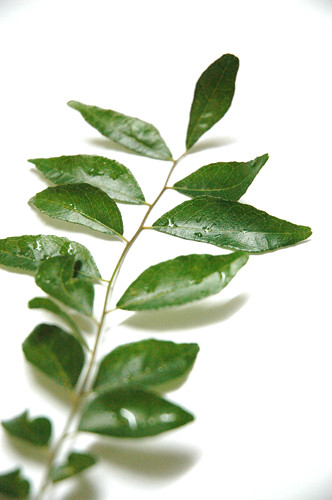
Curry Leaves

My friend Meredith asked me to write briefly about curry leaves.  I'll try to expand on the Wikipedia entry a bit.

First, if you're in New York and you want to know about curry leaves first-hand, go to Chola. Curry leaves are used in the cookery of my birthplace of Durban, South Africa, but they were an import there, probably brought by the earliest of the indentured servants that came as laborers from the south of the subcontinent.

The iconic curry leaf dish at Chola is the Chettinad chicken.  It's chunks of chicken, with hot chillies, curry leaves, and a highly spiced tomato sauce. Absolutely breathtaking, and not too spicy for normal folks to enjoy.

From the various recipes I've cobbled together, curry leaves seem to have an affinity for tomato and spice. I've never tried them in any sort of fusion capacity, but I'd very much like to experiment a bit.

The taste is, to me, tarry and toasty, both in good ways.  It's very much a warm flavor.  

Enough blathering.  Here's the facts:

  • In New York, you can get fresh curry leaves at Dual, and at Little India. I find Little India to be a much better place to shop for actual Indian specialties than the more famous Kalustyan's on the next block.  Kalustyan's is crowded and expensive, with diffident service. Little India and Dual are both friendly and helpful places with reasonable prices.  If you absolutely need to buy Korean black garlic and Welsh smoked salt in the same store, go to Kalustyan's.  If you are interested in cooking, though, I recommend either of these others.
  • The wikipedia entry for curry leaves says you can freeze them.  I have frozen them, but have never actually ended up using them, because I make a stop at one of these stores often enough that it's never come up.
  • To use them, heat vegetable oil in a heavy pot with a lid.  Meanwhile, rinse the sprig of leaves and shake dry.  When the oil is very hot, strip the sprig into it quickly and put the lid on.  The curry leaves will sputter and can burn you.  When the sputtering starts to subside, go on with your recipe.  This is where you can bloom some curry powder, throw in some onions, garlic, ginger, etc.  The leaves will suffuse the dish with a lovely and somewhat indescribable flavor.
  • Most recently, I used curry leaves and hot red chillies in a variation on the Chettinad recipe.  I used whole frozen okra and tofu.  It was heavenly.  You could use just the okra and serve over rice for an awesome vegan curry.
  • I was told by the manager at Chola that southern Indian cooking was characterized by the use of curry leaves and coconut.  I wasn't clear if he meant them to be used together.
  • I am sort of dying to know if they go well with seafood, particularly shrimp.  I made a Madhur Jaffrey recipe the other night, shrimp with crushed black mustard seeds, that I think might work really well with curry leaves instead of mustard.
Let me know if you know anything more about this lovely seasoning.

Photo credit: ImageBang! on Flickr

18 November 2008

Me & JP


I went a few weeks back to see Jacques Pépin speak and sign his new book, More Fast Food My Way, at the the Astor Center.  It was really great.  He had so many memorable things to say:
  • The art of cooking is the art of adjustment, and sometimes, the art of recovery. My mom's the expert here.  I've seen her recover so many dishes that I would've given up on.  People got fed, they enjoyed it, and they were never the wiser.
  • Never apologize and never explain. A motto he passed on from Julia Child.  At most tables where you're setting down food, you know the most about how the dish should be. This goes double if it's a dish of your own creation. If you keep your self-criticisms to yourself, everyone has a better meal.  If there's a fellow chef at table and you tell an out-and-out lie, a simple wink will suffice to keep them quiet.  They'll expect the same discretion from you when they screw something up, though.  (Again, my mom comes to mind... though she has never told a white lie to make her guests more comfortable, right, Mom? [wink])

I can't overstate how much of an influence this man has been on the way I cook.  I think I'm not alone in saying that he elucidated a way of cooking at home that I had always though of, but hadn't trusted myself enough to do.  He's a great force against pretentiousness in the food world and a national treasure.


13 September 2008

The Fish Sauce Postulate

The Fish Sauce Postulate:
If a cook is adventurous, the contents of his fridge and pantry will always be crowded with arcane, unused ingredients unless he has,
a.) a good recipe that uses each ingredient, and
b.) a means for reminding himself to cook that recipe regularly.

Call it, "a use for everything and everything in use."

I've recently embarked upon a quest to have a clear use for everything I have in my kitchen.  So far, it's yielding good results.  I try a lot of different recipes and am always experimenting, so there's a constant influx of interesting ingredients.  The fresh ones that don't get used get chucked pretty quickly, but the long-lived ingredients just end up taking up space.  For instance, I picked up some tamarind paste at Dual Quality Products to try out this recipe.  The results where not awesome, but I am totally down with cooking eggplant in the microwave and have done so to good effect since, just not south Indian eggplant.  But I still have that tamarind paste in the fridge.  And unless I get a recipe that uses tamarind paste, it's going to be there until it goes off (a year from now!) and gets thrown out.

So the pantry list is now more of a whole-house food inventory.  I've added all of these recipes to Bubbalup, my organizational tool (forthcoming soon, I promise), and it's working just brilliantly.  I keep black sesame seeds on hand, and every now and then zakkokumai cha zuke will bubble up on my list, ensuring that the sesame seeds have a chance of some day not being in my pantry.

It makes a lot of sense when you think about it.  Of course, I may be totally insane.