"...said Charlie Kleinman, chef of Wexler’s, a new restaurant doing creative takes on Southern food, like Barbecue Scotch Eggs (soft-poached eggs coated in short-rib burnt ends, deep fried, and served with sweet pea gastrique and hot sauce)."
From this article in the Times.
Weighing in on the subject of the article itself, the difference here is between "produce" and "culture". In SF, it seems the raw materials outshine the food culture, but as anywhere, there's always more going on than the press sees, or than the blogs cover. It's just what gets your attention.
27 November 2009
24 November 2009
Cold-brew Coffee

Cold-brew Coffee
It's often called "Toddy," which is a trademarked term. The trademark belongs to Todd Simpson, who experienced cold-brew coffee while traveling in Latin America in the 1960's and devised, patented, and popularized in America his system for cold-brew coffee.
Here's what I know about cold-brew coffee from some fifteen years of experience with it.
1.) It's caffeinated.
The amount of caffeine in any coffee extraction has primarily to do with how long the water is in contact with the beans. Thus the relatively low caffeine content of espresso (relative to flavor). Cold-brew coffee stays in contact with the beans for a long time, albeit at lower temperatures, and thus has quite a kick.
2.) It's cheap.
The higher the brewing temperature, the better beans you need. At lower temperatures, lower quality beans, which might yield sour hot coffee, only release their coffee-ish flavors, not the sour, acidic notes. My cold-brew recipe calls for Chock Fulla Nuts in the brick form ($5 for two weeks' worth of iced lattes). It's not improved by using pricier coffee.
3.) It lasts.
Kept in a stainless steel bottle in my fridge, cold-brew coffee will remain drinkable for a month, even if it's sitting on some lees (see below). That's just my estimate, of course. I'd try to get through a batch in a couple of weeks for best flavor.
4.) It works mainly for iced coffee drinks.
Some people like to mix cold-brew coffee with hot water for low-acid hot coffee, but I've just never found it that satisfying, and even with boiling hot water and room temperature cold-brew, it usually wants some time in the microwave to get hot enough. And even then, it's just not as good as drip coffee. If you can't tolerate the acid in drip coffee or espresso, it's a decent substitute, but where it really shines is over ice.
5.) It's messy to make.
This is why Mr. Simpson deserves his trademark. He didn't solve the problem of making cold-brew coffee. That's relatively easy. He solved the problem of making it relatively painlessly. Since it lasts and is cheap, cold-brew coffee is best done in large batches. Those large batches leave you handling a pile of swollen coffee grounds and a large quantity of liquid. The problem for me, though, is that I don't want to have yet another single-use piece of equipment in my New York kitchen.
For my recipe, you will need:
- A "pound" of cheap coffee. It's usually 14 oz or so. Most grocery store brands are rated for percolators, which means the grind is large enough to get mostly trapped in a sieve.
- A large sieve
- A whisk
- Two large non-reactive containers (glass, plastic, stainless bowl or pot)
- A non-reactive bottle for storage (and a funnel, depending on the size of the bottle's mouth)
- Paper towels
Remember: Since we're making coffee in volume here, with cheap materials, we're not looking to minimize waste or maximize the amount of coffee. We're looking to get through a messy process with as little bother as possible. You will throw away some viable cold-brew coffee with this method. If you're looking to maximize your coffee, go out and buy a Toddy Cold Brew System.
- Dump the coffee grounds in a non-reactive container. Pour in cold water, whisking as you go, just until the mixture is combined and stirs freely. I'm never sure how much water I use, but I end up filling a 40 oz. stainless bottle at the end of the process. If I don't fill the bottle, I top it up with cold water to make sure I have a consistent strength of cold-brew coffee.
- Cover and leave in refrigerator overnight.
- Place your other non-reactive container in the sink, with the large sieve over it.
- The grounds will have settled overnight. Whisk the grounds-water mixture to get it moving, then, as quickly as possible, dump the whole thing into the sieve. It will catch 95% of the grounds.
- Hold the sieve above the level of the liquid to let it drain for a bit. Just hold it until the stream coming out of it slows down or you get bored. Do not shake or agitate it. Remember, we're trying to minimize mess, not get every drop of coffee. The grounds go in the trash or, better yet, on your compost pile.
- What you're left with is great cold-brew coffee with two problems: bitter foam on top and a layer of sludge on the bottom.
- To remove the top layer of bitter foam (and usually gross little floating grounds), lay a paper towel over the surface of the liquid. When you gather the paper towel into a ball (don't squeeze) and discard it, you'll be discarding some coffee, but again don't worry. Do this two or three times. The paper here is performing the same function your paper coffee filter performs in drip coffee. (By the way, if you're using one of those gold mesh abominations for drip coffee, throw it out. Paper filters make drip coffee better.)
- Let the coffee sit for a while in the fridge while you make breakfast (10-60 minutes). If you can't make breakfast without coffee, ladle a little off the top and preview your work. You're almost there!
- Decant the coffee into the storage bottle (using a funnel if necessary). As you pour, you'll see a layer of sludge that has settled out. It's better to leave as much of this behind as possible. Remember, you're spending five bucks on two weeks worth of coffee here. It's okay to let a little go down the drain for quality's sake. The best thing is to watch the coffee going down the funnel. As soon as it darkens, stop decanting and throw out the rest.
- Store in the fridge for up to two weeks.
Depending on how fastidious you were in the decanting step, you might end up with a layer of sludge (or lees) sitting harmlessly at the bottom of the bottle. Don't shake the bottle when you pour the coffee. The lees will remain on the bottom until you're ready to clean the bottle. When you do, they'll rinse out easily.
Side note/reminiscence: The coffee house I worked in in Cleveland ages ago used cold-brew coffee to make their very popular mochas. The recipe was simple: one part cold-brew coffee, two parts half-and-half, and a good dash of chocolate syrup. We made it by the five-gallon bucket and sold it in 16 oz cups, hot or cold. I figure those drinks ran about 500 calories and 35 grams of fat. (A Big Mac runs about 540 calories and 29 grams of fat.) Put that alongside a butter-soaked scone or a coconut-laden "morning glory" muffin, and you've got quite a treat. We used to get quite a chuckle watching the customers come in for their 1200 calorie "healthy" breakfasts.
Photo credit: http://www.flickr.com/photos/detoxz/ / CC BY-ND 2.0
21 April 2009
Curry Leaves
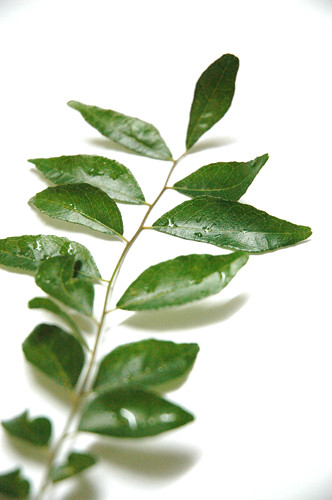 My friend Meredith asked me to write briefly about curry leaves. I'll try to expand on the Wikipedia entry a bit.
First, if you're in New York and you want to know about curry leaves first-hand, go to Chola. Curry leaves are used in the cookery of my birthplace of Durban, South Africa, but they were an import there, probably brought by the earliest of the indentured servants that came as laborers from the south of the subcontinent.
The iconic curry leaf dish at Chola is the Chettinad chicken. It's chunks of chicken, with hot chillies, curry leaves, and a highly spiced tomato sauce. Absolutely breathtaking, and not too spicy for normal folks to enjoy.
From the various recipes I've cobbled together, curry leaves seem to have an affinity for tomato and spice. I've never tried them in any sort of fusion capacity, but I'd very much like to experiment a bit.
The taste is, to me, tarry and toasty, both in good ways. It's very much a warm flavor.
Enough blathering. Here's the facts:
- In New York, you can get fresh curry leaves at Dual, and at Little India. I find Little India to be a much better place to shop for actual Indian specialties than the more famous Kalustyan's on the next block. Kalustyan's is crowded and expensive, with diffident service. Little India and Dual are both friendly and helpful places with reasonable prices. If you absolutely need to buy Korean black garlic and Welsh smoked salt in the same store, go to Kalustyan's. If you are interested in cooking, though, I recommend either of these others.
- The wikipedia entry for curry leaves says you can freeze them. I have frozen them, but have never actually ended up using them, because I make a stop at one of these stores often enough that it's never come up.
- To use them, heat vegetable oil in a heavy pot with a lid. Meanwhile, rinse the sprig of leaves and shake dry. When the oil is very hot, strip the sprig into it quickly and put the lid on. The curry leaves will sputter and can burn you. When the sputtering starts to subside, go on with your recipe. This is where you can bloom some curry powder, throw in some onions, garlic, ginger, etc. The leaves will suffuse the dish with a lovely and somewhat indescribable flavor.
- Most recently, I used curry leaves and hot red chillies in a variation on the Chettinad recipe. I used whole frozen okra and tofu. It was heavenly. You could use just the okra and serve over rice for an awesome vegan curry.
- I was told by the manager at Chola that southern Indian cooking was characterized by the use of curry leaves and coconut. I wasn't clear if he meant them to be used together.
- I am sort of dying to know if they go well with seafood, particularly shrimp. I made a Madhur Jaffrey recipe the other night, shrimp with crushed black mustard seeds, that I think might work really well with curry leaves instead of mustard.
Let me know if you know anything more about this lovely seasoning.
Photo credit: ImageBang! on Flickr
Subscribe to:
Posts (Atom)